
By
Keeta Team
Why Sending Money Abroad Still Feels Like It's the 90s
Why cross-border payments remain slow and how Keeta replaces correspondent banking with real-time, compliant settlement.
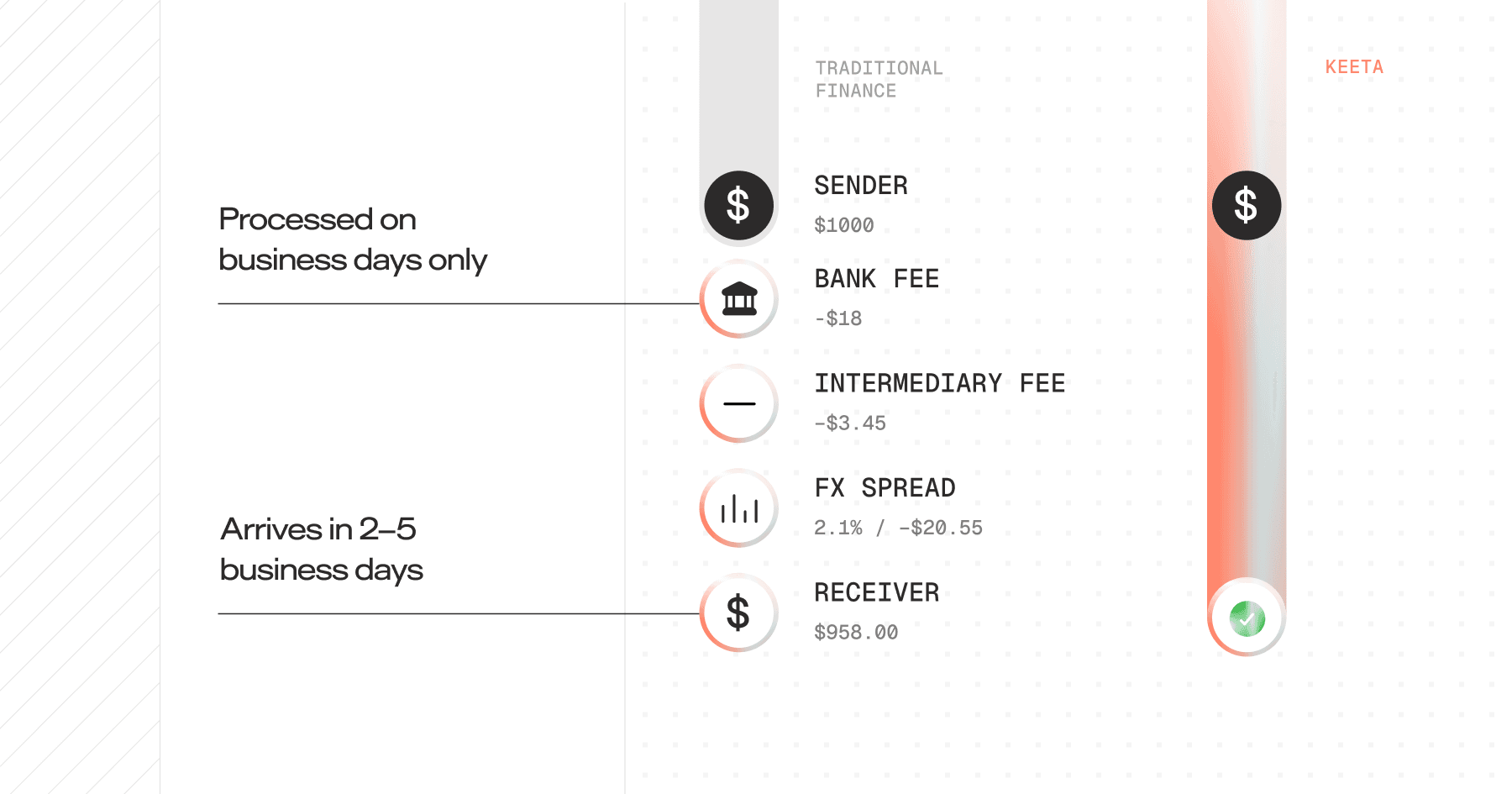
The internet has reshaped how we communicate, shop, consume media, and even manage our health. In three decades, we moved from dial-up modems to real-time video calls with anyone on earth.
Yet if you want to send money to a family member in Lagos, a contractor in Manila, or a supplier in São Paulo, the experience often feels like you’re back in the 1990s.
The reality is that cross-border payments still run on outdated, inefficient infrastructure that was never built for today’s global economy.
The Architecture Nobody Rebuilt
Most international bank payments still rely on correspondent banking: a network of relationships in which banks hold accounts with one another across different countries. When two banks do not have a direct relationship, a payment may pass through several intermediary institutions before reaching a bank that can deliver the funds to the recipient in local currency.
SWIFT sits at the center of this system, but it does not move or settle money. It is a secure financial messaging network that allows banks to exchange standardized instructions about where payments should be sent. The actual transfer of funds still depends on the correspondent banks connected to those messages.
The Bank for International Settlements has tracked the health of this network using SWIFT messaging data, and the trend has been consistently downward. By 2019, the number of active correspondent banking relationships worldwide had fallen by 22 percent from 2011 levels, even as cross-border payment volumes and values continued to grow.
The decline has largely been driven by banks reassessing relationships that require constant anti-money-laundering oversight while producing relatively thin margins.
The result is a system carrying more value through fewer institutions and increasingly concentrated chokepoints than it did a decade ago.
The Idle Capital Problem
Correspondent banking carries a hidden cost: banks must keep pre-funded foreign-currency balances in nostro accounts to settle payments across different markets.
A German bank settling in dollars needs funds at a U.S. correspondent bank. A Singaporean bank processing AED payments needs liquidity at a UAE institution. Repeated across thousands of banking relationships, this leaves substantial amounts of capital sitting in accounts primarily to ensure settlement can occur.
That capital is not being used productively. Its opportunity cost is passed on through higher transaction fees, minimum balance requirements, and decisions about which payment corridors to maintain. Low-volume markets are often the first to lose access because the cost of keeping liquidity available outweighs the revenue they generate.
Real-time settlement changes this model. If value can be transferred and finalized in milliseconds, banks no longer need to hold the same level of standing liquidity in anticipation of future payments. Capital can be committed when a transaction occurs rather than remaining trapped indefinitely.
The result is a payment system that uses liquidity more efficiently and can serve smaller corridors at lower structural cost.
The Mechanics of the Delay
Many SWIFT transfers take one to five business days to complete. Research analyzing more than 5,000 payments found that timing varies significantly depending on currency, corridor, time zone mismatches, and the number of intermediary institutions involved. Each hop in the correspondent chain can add 24 to 48 hours, as each institution conducts its own compliance screening before releasing funds.
The BIS monitoring survey published in 2025 found that only 35 percent of cross-border retail payments are credited within one hour of initiation - against a G20 target of 75 percent. The gap has narrowed only marginally since the targets were first measured in 2023.
Each institution that touches a payment is legally required to screen sender and recipient against sanctions lists, verify the stated purpose of the transaction, flag patterns consistent with money laundering or terrorist financing, and retain records for audit purposes. Applied sequentially across a four-hop correspondent chain, this produces delays measured in days.
What Keeta Built
The problems outlined above are not simply the result of outdated policies or inefficient banking processes. They are built into an architecture that was never designed for the speed, scale, and global reach modern payments require.
Fixing that requires more than improving the interface around correspondent banking. It requires replacing the settlement infrastructure underneath it.
Keeta is a Layer 1 blockchain network built on a directed acyclic graph architecture. In a public 2025 stress test conducted with Google Cloud, the network processed 11.2 million transactions per second while maintaining settlement finality of roughly 400 milliseconds.
On Keeta, settlement can occur almost instantly, before another institution in a traditional correspondent chain would have begun processing the same payment.
Compliance Built Into the Network
Speed alone does not make a settlement network usable by regulated financial institutions. The underlying problem is structural: compliance has been bolted onto payment rails rather than built into them. Keeta builds it into the network itself.
Identity on Keeta can be managed through X.509 certificates attached directly to accounts. KYC is optional at the network level and is only required when a participant wants to access a service that mandates verified identity.
In those cases, the participant verifies once with a trusted issuer - such as a KYC provider, government agency, or regulated institution - and can reuse that credential when interacting with other services that accept it.
When a payment arrives, the receiving party knows the sender has been verified without seeing any underlying personal data. The certificate proves the verification happened; it does not expose the information used to perform it. This is selective disclosure by design, not a privacy workaround. Authorities requiring investigation can trace certificates back to the original issuing institution. Everyone else sees only that the account is verified.
Keeta also includes a rules engine that allows token issuers to attach programmable conditions at issuance.
Transfers can be restricted to participants in specific jurisdictions, blocked from reaching sanctioned counterparties, time-locked until a future date, or held pending administrative approval if the amount exceeds a defined threshold. Those rules are enforced automatically by the network on every subsequent transaction. Issuers can also update rules after a token has been distributed, allowing compliance conditions to evolve alongside regulatory requirements without reissuing the asset.
The Anchor Model and What It Changes
An anchor is a bridge that connects an existing asset or external network to Keeta, allowing its operator to mint and burn corresponding tokens as value enters or leaves the network.
Anchors can represent many forms of external value: a bank can connect fiat currency, a bridge operator can connect assets from another blockchain, a remittance provider can link a local payment corridor, and a commodity issuer can bring a physical asset on-chain.
When value enters the network through an anchor, the corresponding asset is minted on-chain. When it exits, it's burned. This keeps the on-chain supply fully backed at all times and ensures that a bank's tokenized funds are a direct representation of the underlying asset, not a derivative.
Eliminating the Correspondent Chain
The immediate problem anchors solve is correspondent banking.
Licensed financial institutions, including banks, exchange houses, remittance operators, and payment companies, connect directly to every other participant through a single SDK integration.
These institutions provide the link between the network and local financial systems. The sender deposits funds with an anchor in their market, the payment settles directly across Keeta, and an anchor in the destination market delivers local currency to the recipient.
Instead of passing through multiple intermediaries, the transfer moves between two connected endpoints and reaches final settlement in under a second. Compliance remains with the regulated institutions serving the sender and recipient, but the sequential correspondent chain between them is removed.
For an institution that currently maintains separate banking relationships across multiple markets, this replaces a fragmented network of bilateral connections with a single integration that provides access to all supported corridors on Keeta.
Rebuilding the Settlement Layer
Cross-border payments remain slow and expensive because the underlying infrastructure was never rebuilt for a real-time global economy.
Keeta replaces correspondent chains, trapped liquidity, and fragmented compliance with direct settlement, programmable rules, and an open anchor network.
The internet made information move instantly. Keeta is building the infrastructure for value to do the same.
Learn more at: https://keeta.com/
Sources:
World Bank Remittance Prices Worldwide, Q3 2025 -
FSB, G20 Roadmap for Cross-Border Payments: Consolidated Progress Report 2025 -
BIS CPMI, "Enhancing cross-border payments step by step: insights from the 2025 monitoring survey" -
World Bank Migration and Development Brief 40 -
SWIFT, "How long does a Swift payment take?" -
Zanders Group, "End of Days: Calling Time on Swift's Outdated Cross-border Payments Model" -
Inpay, "Why correspondent banking is failing emerging markets" -
TrustSphere, "The De-Risking Dilemma" -
FATF, "Guidance on Correspondent Banking Services" -
Statrys, "How Long Does a SWIFT Transfer Take? 5,000+ Payments Studied" -